.png)
Colorado annual report: filing requirements, deadlines, and penalties
If you operate any business entity in Colorado, you must file an annual report with the Secretary of State to maintain good standing with the state. However, Colorado officially calls them Periodic Reports, not "annual reports." Colorado adopted "Periodic Report" as the official term for this filing, so you'll see it used exclusively in official sources.
This report is Colorado's way of getting a yearly update from your business on some key compliance information, including your registered agent and operating status.
Missing the deadline results in penalties, including loss of good standing status, and possible dissolution proceedings if the delinquency persists for three or more years under C.R.S. § 7-90-908, though dissolution requires active action by the Secretary of State, not automatic termination. Colorado sends email reminders as a courtesy if you sign up for notifications, but each entity is responsible for filing regardless of whether it receives a reminder.
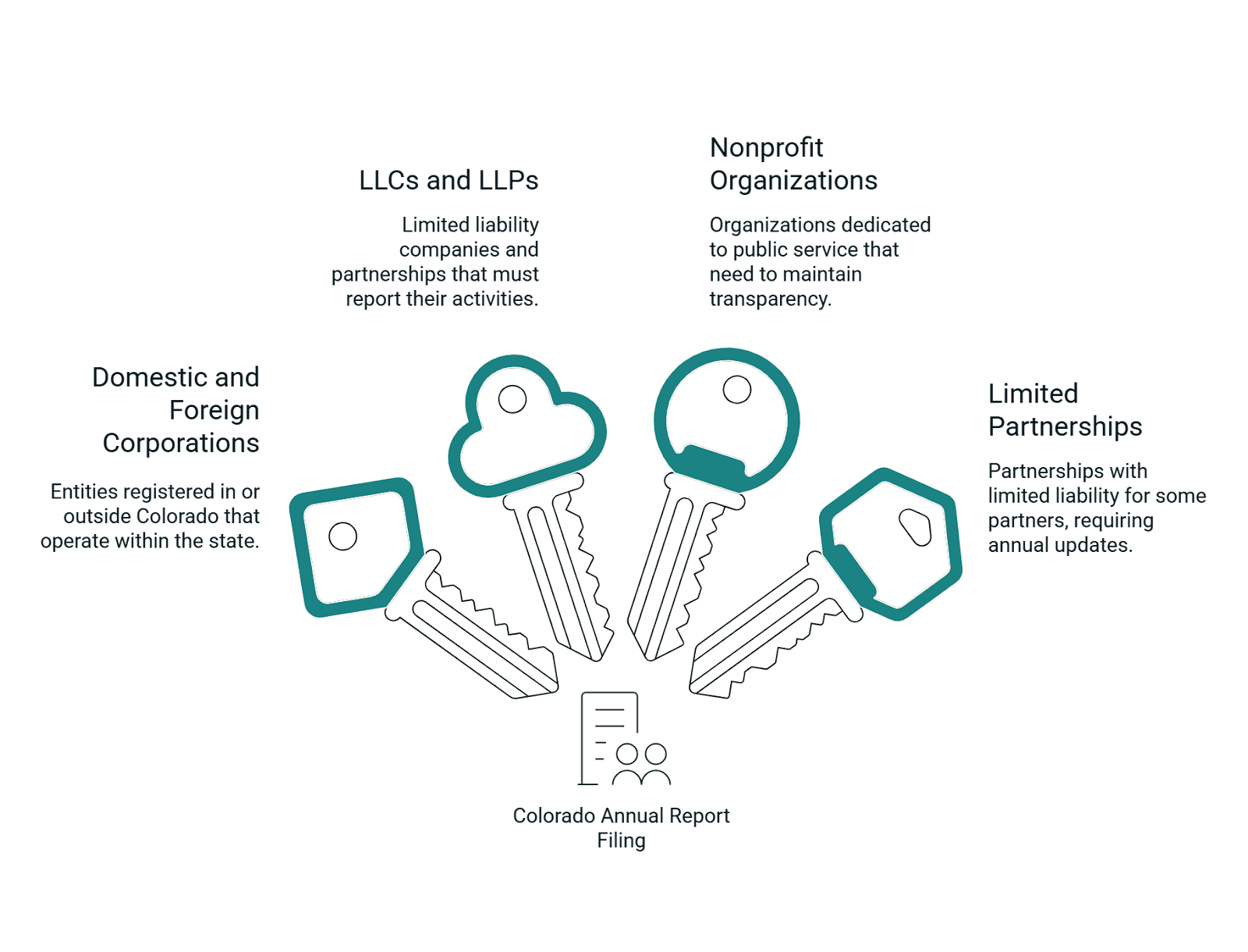
In Colorado, the following entities must file periodic reports with the Secretary of State:
Limited liability companies (LLCs)
Corporations
Nonprofit corporations
Foreign entities authorized to do business in Colorado
Limited liability partnerships (LLPs) and limited liability limited partnerships (LLLPs)
Cooperatives and cooperative housing corporations
Certain limited partnerships (Colorado distinguishes "reporting limited partnerships," generally those formed after July 26, 2009, or those that have filed a registration statement under C.R.S. § 7-90-1101; whether a particular limited partnership falls into this category depends on the specific statutory definitions and any later filings it may have made)
Sole proprietorships and general partnerships are not subject to this requirement because they are not required to register as entities with the state.
Colorado requires filing regardless of your business's revenue or activity levels. Even inactive businesses must continue to file Periodic Reports until they are properly dissolved (domestic entities) or withdrawn (foreign entities). However, Colorado SOS notes you do not need to file a Periodic Report first before filing the appropriate dissolution or withdrawal.
Any authorized representative can complete this filing, including:
Business owners
Members or managers
Officers or directors
Attorneys or accountants
Business managers
How to file a Colorado annual report
Colorado requires Periodic Reports to be filed electronically through the Secretary of State's business portal. The system pre-populates your form with existing information, streamlining the process.
Select "Search business database" to locate your entity
Enter your business name or ID number
Select your business from the search results
Scroll down and select "File a form"
Choose "File a Periodic Report"
Update any changed information (most details are pre-populated)
Review everything on the preview page before submitting
Pay the $25 filing fee via credit or debit card
Save your confirmation receipt for your records
The entire process typically takes 5 to 10 minutes since you'll only need to update information that has changed since your last filing.
Important note on registered agents (effective July 1, 2025): Per HB24-1137, individual registered agents must verify Colorado residency using valid identification and a state-administered verification process. Entity registered agents must be registered with the Colorado SOS and maintain good standing. The Colorado SOS Registered Agent Requirements page confirms that P.O. boxes are explicitly prohibited for registered agent addresses; only physical street addresses are accepted. These requirements apply to any filing that involves registered agent information, including periodic reports.
Due dates and deadlines for Colorado annual reports
Colorado assigns each entity a Periodic Report Month, which is visible on the entity's Summary page under "Periodic report month." The Periodic Report can be filed starting two months before that month and through two months after that month without penalty, creating a five-month filing window.
For instance, if your Periodic Report Month is June:
Filing window opens: April 1st
Periodic Report Month: June
Filing deadline (end of window): August 31st
The report is due by the last day of the second month following your Periodic Report Month. Per the Delinquency FAQ, if the Periodic Report is not filed by that date, your entity's status becomes Noncompliant and a late fee is assessed. Sixty days after Noncompliant status begins, the entity moves to Delinquent status.
Mark your specific Periodic Report Month on your calendar or set up email reminders directly from the Secretary of State to avoid missing deadlines.
Filing fees for Colorado annual reports
Per a Colorado Secretary of State press release, the periodic report filing fee increased from $10 to $25 effective July 1, 2024, the first fee adjustment since 2006. The increase was driven by rising department costs, with the Secretary of State estimating that new election-related laws would increase costs by $6.5 million in FY 2024 to 2025 and $9 million in FY 2025 to 2026. The fee adjustment was authorized under C.R.S. § 24-21-104, which requires the department to set fees approximating its direct and indirect costs.
The current $25 fee applies uniformly to all entity types according to the Business Organizations Fee Schedule.
Required information for filing a Colorado annual report
The system automatically displays your existing information for verification and updating. Per C.R.S. § 7-90-501, all periodic reports must contain the entity name, jurisdiction of formation, registered agent name and address, and principal office address. Rather than filing separate amendments later, updating all information during your annual report filing is more efficient.
Note that registering a DBA (doing business as) name is a separate process from your annual report filing. The annual report focuses solely on maintaining your entity's good standing with the state.
For entities operating in multiple states, remember that Colorado's requirements for foreign-qualified businesses are identical to those of domestic entities regarding periodic reports: same fees, same deadlines, and no additional foreign-entity disclosures required in the Periodic Report itself.
Your registered agent in Colorado can help ensure compliance with all state requirements. If you also manage Florida entities, don't forget that they must file a Sunbiz annual report filing each year by May 1, and you will need a separate Florida foreign entity registration before you start transacting there.
Consequences of not filing a Colorado annual report
Missing your Colorado annual report deadline triggers a series of escalating penalties. The immediate consequences include:
Noncompliant status begins immediately after the Periodic Report due date is missed (at the end of the second month following the entity's report month).
Per the Business Organizations Fee Schedule, late filing includes the standard $25 filing fee plus a $50 late penalty.
Delinquency begins 60 days after Noncompliant status and requires a Colorado Statement Curing Delinquency to restore good standing.
Longer-term, allowing your business to remain in Delinquent status can lead to:
Per C.R.S. § 7-90-903, a delinquent entity may not maintain a proceeding in any Colorado court for the collection of its debts until it cures delinquency.
According to the Delinquency FAQ, on the 401st day of delinquency, the state renames your entity to include the word "delinquent" and the delinquency date, and your original name becomes available for another entity to use.
Under C.R.S. § 7-90-908, the Secretary of State may pursue dissolution proceedings for domestic entities that have failed to cure delinquency for three or more years.
Any previously issued certificate of good standing becomes invalid upon loss of good standing, per the Certificate of Good Standing FAQ, which is critical for fund closings, financing transactions, or regulatory submissions.
Lenders commonly restrict financing or require additional documentation for entities not in good standing.
Operational and licensing difficulties may follow.
For LLCs and corporations, delinquency does not trigger automatic dissolution: entity existence continues under Colorado law. However, delinquent entities may not maintain debt collection proceedings in court until delinquency is cured, and name protection expires after 400 days.
Enhanced cure requirements for long-delinquent entities
Under HB24-1137, entities that have been delinquent for five or more years now face additional requirements when filing a Statement Curing Delinquency. These entities must submit their filing under penalty of perjury, include an affidavit attesting authority of the individual filing, and provide government-issued photo ID. Colorado SOS generally does not refund filing fees when a filing is rejected; confirm the current refund policy at the Colorado SOS fee schedule before submitting.
Automate your Colorado compliance with Discern
Tracking Colorado's rolling five-month filing window across multiple entities is straightforward in isolation, but it compounds quickly when you're managing entities across other states with different deadlines, fee structures, and reporting cycles. Discern automates Colorado periodic report filings and ongoing compliance across all 51 jurisdictions through a single dashboard, so you file on time without manually tracking each entity's anniversary month.
Whether you manage a handful of entities or a portfolio spanning dozens of states, Discern's automated deadline tracking ensures you never miss a filing window. Book a demo to see how Discern handles periodic reports and registered agent services across every jurisdiction.
FAQs about Colorado's annual report
Is a "Periodic Report" the same as an annual report?
Yes. Colorado uses the term "Periodic Report" for what other states call an annual report. Both are mandatory yearly filings that update your business information with the state.
Will I be notified when my report is due?
Colorado sends email reminders as a courtesy if you sign up for notifications through the Secretary of State's office. However, per the Periodic Reports FAQ, each entity is responsible for filing a Periodic Report regardless of whether it receives an email notice.
Can I file on paper?
No. The Periodic Report is filed electronically through the SOS website. Colorado SOS does not provide a paper form or mailing address for Periodic Report submissions.
What if I need to change my business name?
Name changes require a separate amendment filing and cannot be completed through your annual report. Visit the Secretary of State's business forms page for the appropriate documents.
How do I remove delinquent status?
File a Statement Curing Delinquency through the Secretary of State's website. The cumulative cost to cure delinquency is $175: the $25 periodic report fee, plus the $50 late penalty, plus the $100 Statement Curing Delinquency fee. You do not need to pay a separate $25 report fee for each year you did not file; the cure statement is the mechanism that restores good standing in a single filing upon acceptance.
Do legacy limited partnerships need to file?
It depends. Many limited partnerships formed before July 26, 2009, may not be "reporting limited partnerships" unless they have registered under C.R.S. § 7-90-1101, and their periodic report obligations should be evaluated against the current statutory definitions. PE firms and fund managers with older Colorado fund structures should verify their specific filing status directly against the relevant title 7 provisions.
Updated on
2026-03-21